
In this guide
What biophilic design actually is — past the jargon
Biophilia — literally, love of living things — is the idea that humans have an innate need to connect with the natural world. The theory, developed by biologist E.O. Wilson in the 1980s, has since accumulated substantial research backing: exposure to natural materials, patterns, light, and organic forms measurably reduces cortisol, lowers blood pressure, improves focus, and elevates mood.
Biophilic design is the application of this to the built environment. It is not the same as "putting plants in your house." Plants are one element, but biophilic design is broader — it's about introducing natural materials, textures, patterns that echo organic forms, colours drawn from landscape, and spaces that feel connected to the rhythms of the natural world.
In practice, biophilic design in a home means: natural light over artificial, raw materials over synthetic, irregular texture over machine-perfect surfaces, and earthy colour over the clinical whites and cool greys that dominated UK interiors for a decade.
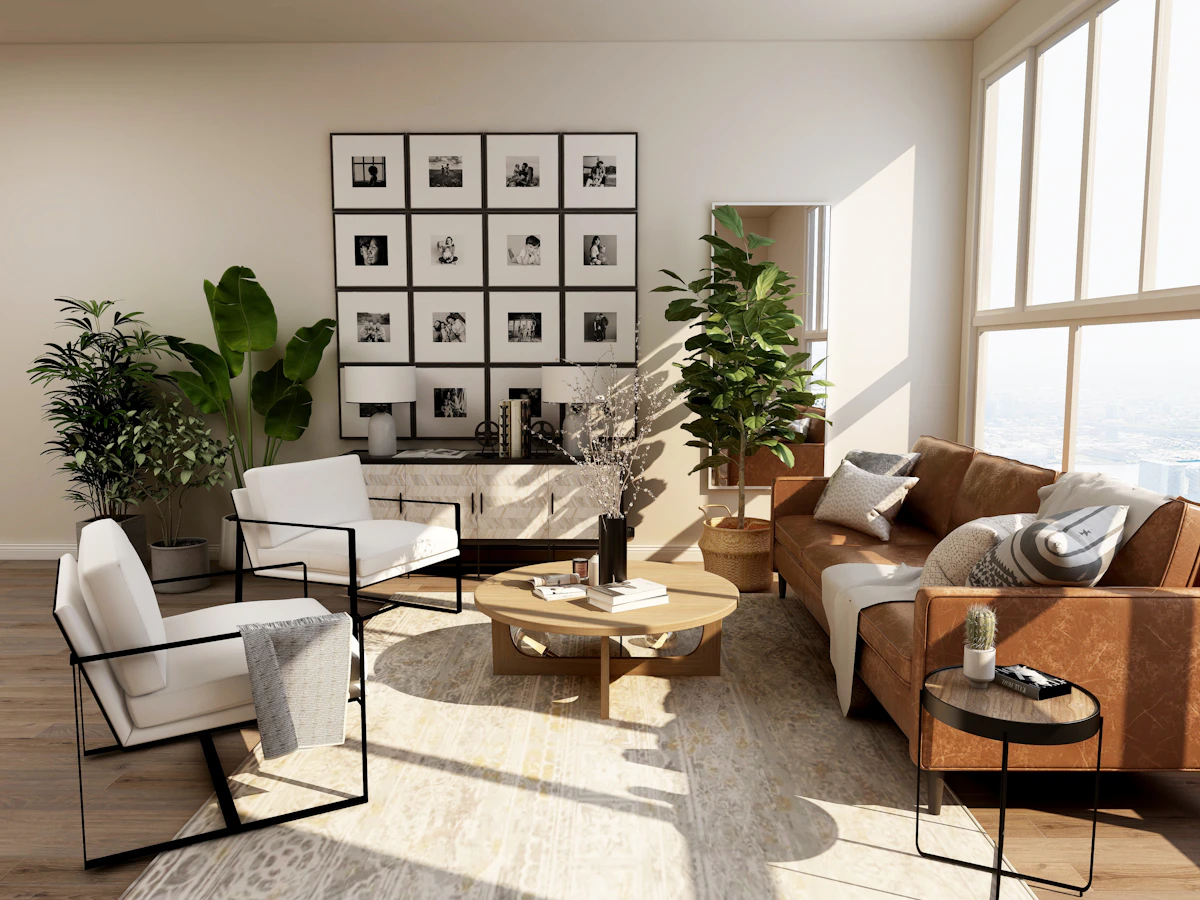
Biophilic design reads as warmth, not wilderness. Natural materials, organic form, and a connection to the palette of the landscape.
Why biophilic design matters more in UK homes than almost anywhere
The biophilic design conversation often plays out in design publications photographed in sun-drenched California or Scandinavia. But the UK case for it is arguably stronger than either.
Light deprivation is real. The UK has some of the lowest daylight hours in the developed world between October and March. Seasonal Affective Disorder affects around 2 million people in Britain. Biophilic environments — warm natural materials, earthy tones, organic textures — are measurably more mood-supporting than cool, clinical interiors when natural light is scarce.
Urban density is high. Over 80% of the UK population lives in urban areas. Garden access, green spaces, and natural views are luxuries many households simply don't have. The interior has to carry more of the load of the connection to the natural world.
Our housing stock works for it. Victorian terraces and Edwardian semis — the dominant dwelling type in UK cities — have high ceilings, original timber floors, cast iron fireplaces, and period cornicing. These are already naturally biophilic architectural features. A handmade wool rug on a restored Victorian floorboard is an almost effortlessly biophilic interior decision.
"When you can't bring nature in through the window, you bring it in through the floor. A handmade wool rug is one of the most direct ways to introduce a natural material surface into a room."
The 5 principles of biophilic design — and where the rug fits in each
Biophilic design researchers broadly identify five categories of nature-based experience that the built environment can provide. Here's how a natural fibre rug contributes to each.
01 Direct experience of natural materials Physical contact with materials from the natural world
The most direct form of biophilic experience is physical contact with natural materials. Wool, jute, cotton, sisal — these are materials the nervous system recognises. Research in sensory environments has shown that contact with natural textures produces measurably different cortical responses than contact with synthetic materials.
This is why the rug — the surface you touch daily with bare feet — carries disproportionate biophilic weight compared to, say, a plant on a shelf or a wood-effect laminate floor.
The rug's role
A handmade wool rug is one of the largest natural material surfaces in any room — often 6 to 9 square metres of material that comes directly from a living creature, processed without synthetic additives in its natural form. Every barefoot step is a direct, measurable biophilic experience.
02 Natural patterns and organic form Irregular, non-repetitive visual patterns found in nature
Nature rarely produces perfect symmetry or machine-regular repetition. Fractal patterns — the irregular-but-structured patterns found in leaves, coastlines, wood grain — are what the human visual system finds restful and restorative. By contrast, perfect geometric machine-made patterns can feel stimulating rather than calming.
This is part of why organic, hand-woven textiles feel fundamentally different to machine-made ones — and why that difference is not merely aesthetic preference but has measurable physiological correlates.
The rug's role
Every handmade rug contains the natural irregularities of the human hand — slight variations in tension, dye uptake, and pattern execution that machine production cannot replicate. These micro-irregularities are precisely what makes handmade textiles feel organically restful rather than artificially stimulating.
03 Thermal and sensory variability Variation in temperature, texture and sensation across a space
Perfectly uniform, climate-controlled environments are physiologically numbing. Natural environments have gradients — warmer in the sun, cooler in shade, textured underfoot and smooth overhead. Biophilic design introduces this variability deliberately into the interior.
In a UK context, this is particularly relevant in winter, when central heating creates artificially uniform warm air that feels disconnected from any natural thermal experience.
The rug's role
Wool is naturally thermoregulating. It retains warmth in winter and releases it in summer, creating a more variable and natural thermal micro-environment underfoot. Walking from a cold wooden floor onto a wool rug is a direct sensory gradient experience — the kind the nervous system responds to positively.
04 Biomorphic forms and natural colour Colours and forms drawn from the natural landscape
The colours humans find most restorative are drawn directly from the natural landscape: the earthy ochres of bare soil, the muted greens of lichen and sage, the warm terracottas of sandstone, the deep blue-greens of still water. These are the tones that trigger the automatic positive response that evolved from navigating natural environments.
Cool synthetic greys, stark whites, and neon accents have no correlate in the natural landscape — and research consistently shows they produce less restorative environments.
The rug's role
Natural dyes from plants and minerals produce exactly the palette biophilic design calls for — not because it's fashionable, but because plant-based dyes are, by definition, drawn from the natural colour palette. A terracotta, sage, or warm stone rug covers the largest horizontal canvas in the room with landscape colour.
05 Connection to craft and human process Objects that carry evidence of human making and natural time
A fifth and sometimes underemphasised principle in biophilic design is connection to process — the human and natural world evident in how objects are made. Objects that carry the marks of their making (the variation in a thrown pot, the texture of a hand-loomed textile) reconnect us to the idea of time, labour, and natural process in a way that machine-perfect objects cannot.
This is distinct from nostalgia. It's about environments that feel inhabited by process rather than produced by automation.
The rug's role
A handmade rug can take weeks or months to produce. That accumulated human time is present in the object — in the way the dye catches slightly differently across its width, in the hand-finished fringe, in the slight variation in pile height across the face. These are not defects. They are the biophilic content of the object.
Why the rug — not the plant, not the wood shelf — is the foundation
Interior design content about biophilic design tends to reach for plants as the primary recommendation. Plants are genuinely valuable, but they are decorative accents — not structural elements. A trailing pothos on a bookshelf is a nice detail in an otherwise biophilic room. In a synthetic, clinical room, it's a token gesture.
The rug, by contrast, is the largest single natural material surface in most rooms. A 200 × 290 cm wool rug covers nearly six square metres of floor — the equivalent of several large walls of natural material. Nothing else you can add to a room changes its material character as completely, or as immediately.
It is also, crucially, the material you are in constant contact with. Your feet touch the rug every time you cross the room. That repeated physical contact with natural material is a direct biophilic experience in a way that a plant you look at but never touch is not.


Start building your biophilic interior from the floor
Browse Haniesta's natural fibre collection — wool, jute and cotton rugs made by hand, using natural dyes.
Shop natural rugsNatural materials for biophilic spaces — what each brings
Not all natural fibre rugs are equal in their biophilic contribution. Here's an honest breakdown of what each material brings, rated for the things that matter in a biophilic interior.
Wool
Sheep fleece — renewable annually
The definitive biophilic rug material. Naturally renewable, biodegradable, thermoregulating, and soft enough for barefoot contact. Its slight natural lanolin scent is a genuinely biophilic sensory detail.
Jute
Plant bast fibre — tropical grass
Visually the most biophilic — its raw, earthy texture reads unmistakably as natural. Best in living rooms and hallways on hard floors. Avoid in damp environments and don't expect barefoot softness.
Cotton
Plant boll fibre — natural cellulose
Soft, naturally derived, and takes natural dyes well — making it an excellent vehicle for the earthy biophilic colour palette. Best in bedrooms and lighter-use spaces. Less durable than wool under daily foot traffic.
Kilim wool
Hand-woven flatweave — wool warp and weft
The strongest biophilic pattern content of the four — traditional kilim motifs are based on natural forms and geometric abstractions of the landscape. Carries significant craft heritage and biomorphic pattern value alongside its natural fibre credentials.
The biophilic colour palette — what to choose and why
The colours that work in a biophilic interior are not chosen for trend. They're drawn from the actual palette of the natural world — the tones that the human visual system evolved reading as safe, nourishing, and restorative. Here's the palette and what each colour does in a room.
Forest sage
Lichen, moss and olive leaf — the most immediately restorative green
Terracotta
Iron-rich soil and sandstone — earthy warmth without aggression
Warm stone
Limestone and chalk — the neutral that never reads as cold
Deep teal
Still water and wet slate — depth without darkness
Ecru / undyed
Raw wool and birch bark — the most honest natural tone
Chocolate earth
Dark soil and walnut — grounds and anchors a space
What to avoid: Cool synthetic grey, stark white, and clean navy have no correlate in the natural landscape — which is why they tend to feel stimulating rather than restorative. They work in design contexts, but not in a biophilic one. If your existing walls are cool grey or white, the rug becomes even more important — it's doing the work of bringing warmth into a room the walls are actively removing it from.
Room by room — biophilic rug choices
Biophilic design looks different in each room, because the relationship to nature you're trying to cultivate is different. Here's how to apply it across the four key spaces in a UK home.

Living room
The primary biophilic canvas in the home — the space where connection to nature has the greatest daily impact.

Bedroom
The biophilic goal in a bedroom is restoration and calm — materials that signal safety and groundedness to the nervous system at the end of the day.

Hallway
The threshold between outside and inside — the hallway is biophilically important as a decompression zone, a place of transition from the street to the home.

Home office
Research on biophilic workspaces is some of the strongest in the field — 8% improvement in cognitive performance, 13% improvement in wellbeing, measurable reductions in fatigue. The home office is where biophilic design earns its keep most concretely.
4 practical starting points for a biophilic home
Start with the floor
A natural fibre rug is the highest-impact single change you can make to a room's material character. It covers more surface area than any plant, shelf or feature wall.
Choose warm over cool
In a UK home where grey skies are the default view, interior warmth is not decorative — it's corrective. Earthy tones in furnishings compensate for what the light doesn't provide.
Layer natural textures
Wool rug, linen cushions, wood surfaces, ceramic vessels — each natural material adds another layer of tactile and visual nature connection. No single element does it alone.
Choose things that age well
Natural materials — and specifically handmade ones — age into their environment rather than degrading away from it. A well-chosen wool rug looks better at 10 years than it did at 1.
Build your biophilic interior from the floor up
Haniesta's natural collection — handmade wool, jute and kilim rugs in earthy, restorative tones — is where most biophilic homes start.
Shop natural rugs Wool collectionFrequently asked questions
What exactly is biophilic interior design?
Is biophilic design just a trend?
Do I need lots of plants for a biophilic interior?
Which rug material is most biophilic?
What colours should I avoid in a biophilic interior?
Can I do biophilic design on a budget?
Does biophilic design work in a modern UK flat?
Want to go deeper?
Read our sustainability guide to understand the environmental case for natural fibre rugs, or explore our 2026 colour forecast for which earthy tones are defining UK interiors this year.
Browse natural rugs →


